
David Evans, Ramblin' on My Mind - New Perspectives on the Blues. University of Illinois Press, Chicago, 2008, ISBN 978-0-252-07448-6, 432pp, US$27.00.
FolkWorld Issue 36 07/2008; Book Reviews by Walkin' T:-)M
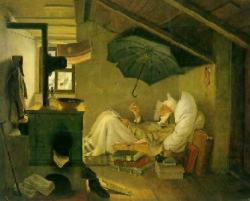
Let's go on a musical journey starting in Africa, following the slave ships across the Atlantic to North America, further on to Europe, it rather is a luxury liner now, so let's have a refreshing drink on deck and enjoy the sunset. However, before we might relax, we have to appreciate the fact that in the beginning of it all is ... the Blues!
Composer Antonín Dvořák wrote about the US: The future music of this country must be founded upon what are called the negro melodies. In the negro melodies of America I discover all that is needed for a great and noble school of music. Indeed, a new school of music drew its vitality from the genuine soul music of the slave cabins to guide the world's aesthetic vision of the 20th century.
There has been a lot of arguments about the 12-bar scheme and the so-called blue notes. Africanist Gerhard Kubik explored how the blues scale was created from specific African sources, and he came to the conclusion that a west-central Sudanic scalar template is the likely basis for most blues scales. Origins would be both the ancient savanna pentatonism and the Islamicized declamatory vocal style with microtonal wavering and a string bourdon-like basis of the tonal process. He also notes:
I eventually arrived at the sacrilegious conclusion that the blue notes as a concept had no cognitional reality in the communities concerned but that they were a Western construct, reflecting a Western cognitive problem in the encounter with African American music. This was not meant to say that the pitch values characteristic of blue notes did not exist. They do exist, of course, but as intrasystematic units and not as deviations from another tonal system.
Kubik's is just one essay in Ramblin' on My Mind. This compilation by distinguished scholars and writers is exploring seemingly neglected aspects of the Blues.
|
David Evans, Ramblin' on My Mind - New Perspectives on the Blues. University of Illinois Press, Chicago, 2008, ISBN 978-0-252-07448-6, 432pp, US$27.00. |
The Blues ain't nothing but a good man feeling bad Folklorist John Minton explores the origins of a regional and ethnic derivative of
blues called
zydeco, the accordion-based African-French R&B of Louisiana
(-> FW#36).
According to Creole folk etymology,
zydeco is said to be cognate with the French les haricots (beans), as in
les haricots sont pas salés -
the snap beans aren't salted, being a metaphor for hard times.
Like blues describing hard times and the music that expresses and eases the pain,
as Lightnin' Hopkins
would sing: Let's go zydeco 'cause times gettin' hard down here.
These essays are of different depths, but
every blues fan (indeed, any music fan) should find something interesting and new.
Editor David Evans himself examines the nicknames of blues singers from a
sample of 3,000 artists, including all recording artists between 1920 and 1970.
For example,
Pinetop Perkins
(height or a style of upturned hair -> FW#33),
Son Seals
(family relationship -> FW#35),
Honeyboy Edwards
(food and/or sexual nickname -> FW#36),
Muddy Waters
(forces of nature -> FW#25).
Only the nickname Taj Mahal
(-> FW#29)
falls completely outside any observable pattern of
blues nicknaming. It was adopted by an artist who is more properly part of the
folk music revival scene.
Gillian Mitchell, lecturer in the Department of History at the University of Wales in Bangor,
reminds us that the folk revival which emerged in the 1940s and reached its apex in the mid 1960s possessed a tremendous variety and complexity.
There were four principal strands within this North Eastern American urban phenomenon
that spread across the continent and eventually to Western Europe,
united only by an optimistic, pluralistic and inclusive vision of the continent as a
tapestry of diverse, rich cultures.
The US part of the story has been told more than once
(-> FW#31),
That's a feeling that I've often had
Wish I'd died when I was young
Then I wouldn't have this hard old race to run
Essentially, the movement represented a large umbrella under which gathered a
plethora of musicians, students, academics, political and social activists,
special-interest groups of various kinds, and admirers, young and old. Budding
composers of anti-nuclear and civil rights protest songs, earnest graduate students
with a passion for obscure Appalachian string-bands, and those interested in
topping the charts with a new folk ballad, thereby becoming the next
Kingston Trio,
all found a place within the revival.
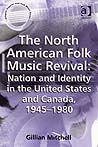
Gillian Mitchell, The North American Folk Music Revival: Nation and Identity in the United States and Canada, 1945–1980. Ashgate, Aldershot, 2007, ISBN 978-0-7546-5756-9, 222pp, £55.00. |
Mitchell's originally was a phd thesis, the focus is on analysis not telling anecdotes. Though a scientific study, it is not tiresome and incomprehensible. Especially thanks to the focus on Canada, it should belong in any proper collection.
In 1967, Canada celebrated the hundredth anniversary of the existence of their nation. The Maple Leaf flag replaced the Union Jack and "O Canada" became the national anthem. Considerable numbers of performers who were persuing successful careers - Joni Mitchell, Neil Young (-> FW#31), Leonard Cohen, Ian and Sylvia, Gordon Lightfoot (-> FW#28), Buffy Saint-Marie, The Band, Bruce Cockburn (-> FW#13, FW#21), Murray McLauchlan, Stan Rogers, K.D. Lang - had their roots in the folk revival. Now they wrote their own acoustic songs. Their music was considered a quintessentially Canadian mode of expression, their sound was described as gentle, introspective and folk-based, as characteristically Canadian as the rolling western prairies or the gentle hills of the Ontario countryside.
In the US at the same time, the political climate changed to the worse. Folk artists lost their faith in the forces of social change and retreated into personalised worlds of self-analysis and introspection.
The turbulent events in the United States led many ex-revivalists to turn away from politics and embrace new identities as introspective singer-songwriters. The revival during the 1970s did not represent a continuation of the enquiring eclecticism of the early years of the previous decade, but was, rather, largely symptomatic of the reactionary self-absorption of the so-called 'me decade'. It appeared to be a personal quest for roots and a display of nostalgia for the romanticised world of one's forebears, real or adopted, as well as a reaction against the alleged, often-lamented banality of the music industry and its heavily commercialised character. Many of those who remained interested in traditional folk music styles, such as Celtic or Klezmer music, tended to be very insular and conservative in their approach, rather than linking their chosen genre to a wider world of folk music.
David Crosby (-> FW#30) once said: I don't dig politics. I don't think politics is a workable system any more. I think they gotta invent something better. Escape into mythical worlds, also borrowed from folk traditions, psychedelia and drugs became key factors in music. Many popular bands were British in general, and Scottish in particular.
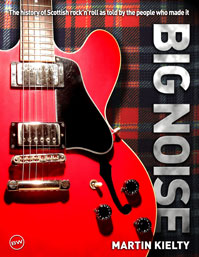
Martin Kielty, Big Noise - The Sound of Scotland. Black & White, Edinburgh, 2006, ISBN 1-84502-107-X, 181pp, £14.99. |
Scotland's first punk made it big in 1956 with a top ten hit that changed popular music for ever. His name was Lonnie Donegan (-> FW#24), his hit was a cover of Leadbelly's "Rock Island Line", and he invented skiffle. Within weeks the whole world was joing in.Pete Agnew of rock band Nazareth remembers:
Lonnie's offering was completely new. That's because anyone could play it. Suddenly you didn't need to read music or play with advanced sophistication. It was about having soul, having a vibe, and it wasn't restricted to those who'd had the commitment to go away and learn their trade. If folk like Elvis and Bill Haley had captured the mood of a generation, Glasgow-born Lonnie had given everyone a crash course in the language.
Some school mates and I got together and called our group the Spitfires, and we entered the Fife Under-fifteen Skiffle Competition at the ABC in Kirkcaldy. It was our very first gig - I was the singer and my mates had their big brothers' acoustic guitars, and they couldn't play one single chord between them. And we won the cup! It gives you an idea of the standard of musicianship at the time ...The McDevitts had a hit with "Freight Train" (-> FW#31). While the press described it as the sound of throttled canaries, the kids were going wild and audience reaction is best described as pre-Beatlemania. After skiffle came the beat boom, followed by the next musical craze.
The folk influence was returning to mainstream noise, assisted by several substances which translated it into psychedelia. At the very forefront in those early days was Scotland's very own Donovan (-> FW#30), whose first relase, "Catch the Wind", very much caught the spirit of the coming years. So too did Bert Jansch, a doyen of the Edinburgh folk scene. His self-titled album displayed rare guitar prowess and songwriting ability, and was to lead to his direct influence on artists as diverse as Jimmy Page and Neil Young.
The Incredible String Band released their debut album. "Amazing Grace," played by the Pipes and Drums and Military Band of the Royal Scots Dragoon Guards, became the best-selling single of 1972. Peter Kerr:
All the American companies were setting up in the UK, instead of having licensing deals, so they were serious about building up their own catalogues. They wanted a dozen or so British ethnic albums quick. So I was told they wanted a pipe band. I'd heard the Royal Scots Grey were heading home after a stint in Germany. We went into the barracks with a portable studio, with just one day to record, and at the end we were a few minutes short. They said, We've been messing about with this Judy Collins hit. So I said, Okay, go! and they played "Amazing Grace". We put it in the can in one take. When I sent the tapes to RCA I said, Take a listen to the last track - everyone here got a buzz from it. They phoned and said, Have you gone mad up there, asking us to release a single with fucking bagpipes on it? Then the DJ Keith Fordyce played "Amazing Grace" on his military spot, and the BBC got so many calls and letters and passed them all on to RCA. The demand was so great that every plant in Europe was involved in pressing those singles. The last figures I saw, including compilations, was thirteen million copies! It shows you how much record executives know about anything ...
Scotland had more to offer: the folk duo The Humblebums, featuring Gerry Rafferty and Billy Connolly; Dougie MacLean released his "Caledonia" album, and Stuart Adamson (-> FW#36) founded Big Country. Mike Scott and the Waterboys (-> FW#20, FW#27, FW#31) appeared on the scene, before moving to Ireland and releasing the folksy "Fisherman's Blues". Simple Minds had their moment with "Belfast Child", drawing heavily on the traditional tune of "She Moved Through the Fair".

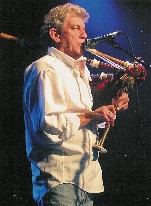
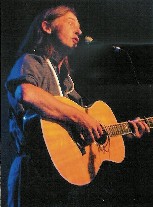
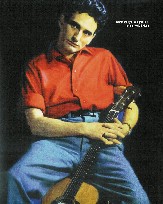
50 Years Scots Rock'n'roll: Donnie Munro (Runrig), Dan McCafferty (Nazareth), Dougie MacLean, Lonnie Donegan
|
Gaelic rockers Runrig (-> FW#6, FW#10, FW#24) became a stadium band. Singer Donnie Munro (-> FW#22, FW#32):
Obviously, we grew up with traditional music, but we pretty much rejected it at the time in favour of rock'n'roll. But when we all went to uni, we grew to appreciate those traditions because we'd been removed from them. So it was an easy decision to try merging those influences. I suppose people tend to see us as a political band - but I don't think any band really can be. I mean, we were six people who could hardly agree on the bloody set list, far less any major political issues! But in the songs we did focus on things like land issues, language and the right to self-determination within communities.
The word of 1995 was Freedom! thanks to Mel Gibson's Braveheart movie. At the same time Runrig took "An Ubhal As Airde" into the Top 20, the first hit to be sung entirely in Scots Gaelic. Eventually Donnie Munro went into politics.
Music journalist and band manager Martin Kielty's Big Noise presents fifty years of Scottish rock'n'roll history in the words of the people involved. His motto: let people say what they want to say, try not to get in the way, but stitch it together so that it makes sense, and hope there's an underlying truth in there. It is an informative but easy-going writing about bands you never heard of beyond the Scottish borders, as well as famous artists you never would have thought were Scottish.
Let us stay in Scotland on behalf of the country's other prominent export article besides music - uisge bheata, the water of life, the ecstasy-inducing heavenly nectar, Scotland's answer to Prozac, whisky!
Robin Laing's The Whisky River is the kind of book I immediately fall in love with, even before reading the first line. It brings together two passions of mine, whisky and song.
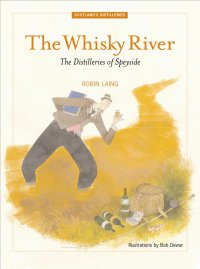
Robin Laing, The Whisky River - Distilleries of Speyside. Luath Press, Edinburgh, 2007, ISBN 1-905222-97-1, 205pp, £12.99. 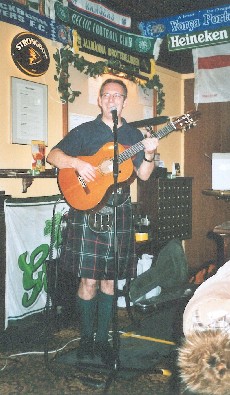
Robin Laing @ FolkWorld: FW #1, #5, #13, #24, #26, #31, #33, #33, #35  De'il's Awa' Wi' th' Exciseman
Lochanside / Nancy's Whisky Shining Clear / Tak' a Dram |
The Scottish singer-songwriter set out to visit the distilleries in the Speyside area, where half of the distilleries in Scotland are located. The top four best selling single malts in the world are all Speysides.
Robin's spiritual guide is one
Alfred Barnard, author of 1887's "The Whisky Distilleries of the United Kingdom."
In Robin's eyes, the greatest value is that Barnard clearly understood that whisky is about poetry as well as engineering:
When he is not recording endless technical details, Barnard is eloquent and poetic
about the landscape, about the history and about the cultural and social context of whisky-making.
He revisited the same sites, the facilities and their surroundings,
over 50 distilleries. Robin's obvservations include a site description,
its history, the current state of business, stories and anecdotes,
snippets of songs and poems.
He discusses new developments and trends, thus is up-to-date, and points to
visitor centres in case you like to see the Whisky River itself.
Differently as Barnard, he gives tasting notes and even some
cocktail recipes (if you don't want the real thing).
But Robin is also interested in engineering and provides some interesting details,
something usually not to be found in your average whisky guide.
Though reading for non-technicians can become a bit tiresome at times.
I spare you with endless technical details, rather finish off
with some of Robin's wittier remarks (best if you pour a dram now).
There was one McCallum who committed suicide by drowning himself in Campbelltown Loch,
thereby providing part of the inspiration for the famous song
"Campbelltown Loch - I wish you were whisky."
On Knock Hill, Macbeth is supposed to have met with the three witches:
This is essential reading for the whisky connoisseur. There might be other guide
books about Scotland in general and Speyside in particular, there might be other books
about Scottish whisky - but forget about them, you only need this guide
to the heartbeat of a small country in the North West of Europe.
Slainte!
By Benromach and Balmenach and Benriach I will go
For the Whisky River's calling me away
By Tormore and Tamnavoulin, by Aultmore and Tomintoul
For a spiritual sprauchle by the Spey
There's a wee dram waiting at the end of every mile
From Dufftown all the way to Dallas Dhu
And a wee sensation that will surely make you smile
At Knockando, Caperdonich and Cardhu
For the heid or for the body, taken neat or in a toddy
As a medicine it canny be surpassed
If you're fightin off a lurgie, you can gargle wi' Glenburgie
If you're feeling rather blue then try a double o' Dailuaine
If you're miserable and fluish hae a drappie o' Drumguish
And for any kind o' pain scoop a shot o' Allt a Bhainne
And Balvenie is Viagra in a glass
It seems perfectly possible that Macbeth did not meet three witches with a
cauldron at all, but rather three monks round a mashing vessel - and Macbeth
having sampled some of their aqua vitae, didn't remember things too well but
felt that some kind of spell must have been involved. Thus Shakespeare, unwittingly,
may have given us one of the first historical accounts of whisky-making in Scotland.
Aberlour to Tomintoul, thirty mile as the corby flees
But yon wee bit of travelling has brought strong men to their knees
You're looking a bittie puzzled, gie'ing me a gey queer look
Foring me tae jalouse that you've never read the book
The ABC of whisky, cornucopia of delight
That makes Aberlour to Tomintoul a hell of a Saturday night
|
To the German FolkWorld |
© The Mollis - Editors of FolkWorld; Published 07/2008
All material published in FolkWorld is © The Author via FolkWorld. Storage for private use is allowed and welcome. Reviews and extracts of up to 200 words may be freely quoted and reproduced, if source and author are acknowledged. For any other reproduction please ask the Editors for permission. Although any external links from FolkWorld are chosen with greatest care, FolkWorld and its editors do not take any responsibility for the content of the linked external websites.

 @
@