|
T:-)M's Night Shift Musical Traditions of Northern Ireland |
|
FolkWorld Issue 40 11/2009; Book Reviews by Walkin' T:-)M
|
T:-)M's Night Shift Musical Traditions of Northern Ireland |
|
“Since Dermot MacMurragh - bad cess to him for that same - invited the English into Ireland, the counthry has nivir been quit of them...” True, and despite the extraordinary success of the peace process, Northern Ireland still remains a divided country in which traditional culture in all its manifestations is widely used as a marker of religious affiliation and ethnic identity. Is it really so? Was it always so?
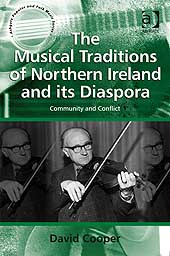 David Cooper, The Musical Tra-ditions of Northern Ireland and its Diaspora - Community and Conflict. Ashgate, 2009, ISBN 978-0-7546-6230-3, 202pp, £55.00 |
Well, yes and no! Still, flute bands and lambeg drums are regarded as Protestant, Irish dance music and bodhrans are regarded as Catholic.
Stop it!, David Cooper cries out. It isn't really that simple as Hast & Scott (FW#30) would have it: Such a mind-set will inevitably tend to characterize the Protestant population in Ireland as a whole as an alien colony whose presence lacks moral and legal justification.
Things are much more complicated, even at an early stage:
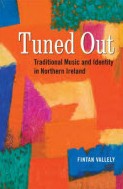
Fintan Valelly, Tuned Out: Traditional Music & Identity in N. Ireland |
|
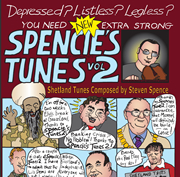
Possibly the most prolific Shetland fiddler of his generation, and composer of around 100 tunes, Steven "Spencie" Spence's second book of tunes is welcome indeed. A long-time member of Hom Bru, Spencie has recorded several of his compositions with them: other musicians have also been quick to pick up his outpourings in Shetland and beyond. This second collection contains 36 tunes, mostly commissioned by fellow Shetlanders, and some which just happened or which were written to mark important events.
There are many memorable tunes here. Waltz for Frances is a beauty, for dancers or listeners. Taraheim Two-Step and Billy's Return to Hollygarth are fine examples of Shetland two-steps. Reels make up the lion's share of this volume, most of them with traditional stepladder arpeggios: Ailsa's Memories O' Yell is a good one, with enough meat in it to be slowed down and played as a hornpipe. Ross's Reel is another. Spencie's style becomes apparent as you play through the collection: simple melodies, nothing too fancy, but very pleasing to the ear. The titles are less imaginative than in the first volume - a constraint of commissioned work, I suppose - but there are notable exceptions such as Sarah's Holie Socks, Lang Lippened,and the priceless.Shetlink Fokk.
As with the previous volume, this book is festooned with the colourful cartoons and wit of the enigmatic FRR. There are also photos of many of the people and places commemorated in the tunes, and some historic shots (monochrome and colour) of rural musicians at work. A companion CD features Spencie playing all 36 tunes, arranged in 14 sets, with backing from Alice Mullay and Jonathan Ritch on keyboards and bass. And of course, if you want to commission your own tune from Spencie, just browse to www.spenciestunes.com where there's a whole cottage industry around Spencie's Tunes.
Steven Spence, Spencie's Tunes 2.
2008, 80pp, £11.99 (CD also available).
|
James Perry was an ordinary Protestant country musician who was active both before and after the 'revival' period of the 1950s a a fifer, a fiddler and a flautist. He was born and spent his entire life in the 'Ulster Scot' heartland of Northern Ireland, near Ballymena in County Antrim. He was not exceptional, but he flourished before more extreme manifestations of the politicization and polarization of traditional music.James Perry's daughter Ray Weir remembers:
After he left school at 13 the drum maker the late John Leckey gave him a fife and taught him to play. He played his first 12th day aged 15. He heard a man playing the fiddle so he knew he wanted to learn it. He played all types of music and played for Irish nights, Orange Dances, Irish dancers and classical musical evenings. The fiddling crossed the divide of religion and all types of music were played. During the 50s and 60s he took up flute playing and taught several bands. He liked Scottish songs and dance music - later he played for Scottish dances.
|
Traditional music played a great part in many Ulster homes. I remember every Friday night our big
kitchen was packed with fiddlers and men with tin whistles ...
I eventually got the chance to dust off my old Waltons pennywhistle
that I hadn't touched for ten years or so.
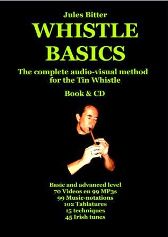
Jules Bitter from Zeeland in south west Holland,
who had been taught whistle and flute by Tommy Keenan,
presents the English edition of his tutorial for the tin whistle,
first published in Dutch a year ago.
Jules' goal is to give basic skills and insights to play the whistle in a traditional Irish way.
His method teaches step-by-step how to use 15 specific techniques and ornamentations
by way of 45 Irish airs and dance tunes.
One moment you're just fingering out positions on the whistle, on the next page you're thrown into cold water
and have to deal with tonguing, cuts, rolls, cranns etc.
It pretty soon gets quite advanced, and you would easily get lost here
(no coincidence that he depicts an ornamentation of Celtic art on the very same page)
without the accompanying CD
including 70 videos and 99 mp3 files. This is quite useful. I find it also very helpful that Jules
introduces ornaments with symbols above or beneath the base note instead of notes on the staff.
This beautifully illustrated tutorial is more than just a start, Jules
discusses some music theory related to traditional Irish music,
as well as rhythms, measures and metres
(Jules is also the author of 'The Irish Beat Conductor', a
CD with percussion tracks to practise rhythmic play).
Whistle Basics is also available as single enhanced CD,
a fully digital edition of his method
including the audio and video files of the aforementioned plus
all 18 chapters of the book as full colour pdf files.
Jules Bitter, Whistle Basics - The complete audio-visual method for the Tin Whistle.
2009, ISBN 978-90-8570-447-8, 113pp, £11.99 (Book & CD).
Jules Bitter @ FolkWorld: FW#24 |
My own interest in vernacular music developed as a child growing up in Belfast though at that stage I certainly didn't classify it using the term 'traditional'. In line with contemporary taste, some of it I would have thought as folk music: the Clancy Brothers and Tommy Makem, and the Dubliners; my uncle singing popular local favourites as 'The Spinning Wheel', 'There's a Colleen I'm Courtin' from Portballintree' and Percy French songs at church suppers. Then there was the music played by the bands on the Orange parades that my grandfather and most of the men from his village in mid-Antrim annually processed in on the Twelfth of July. In the weeks leading up to Christmas in the first few years of Grammar School, we would be dragooned into learning Scottish dancing in preparation for the annual Christmas party. And there was community singing around the piano in various venues and contexts at school and home: 'Black Velvet Band', 'The Wild Colonial Boy', 'Irish Rover', 'The Leaving of Liverpool' and 'The Holy Ground'. It was when I was 19 and had just arrived at the University of Leeds as an undergraduate music student in 1975 that I was advised that the Dubliners and their ilk were by no means the 'real thing' and that I should listen to The Chieftains 4 LP, released the previous year, if I wanted to hear proper Irish folk music. Naturally The Chieftains were a musical revelation.The Musical Traditions of Northern Ireland and its Diaspora has been published in the Ashgate Popular and Folk Music Series (see also FW#36). This comprehensive study begins with a history of the region, discusses the traditional music of the area, its songs and texts, its particular regional performance practices, the influence of pipes and fifes.
David Cooper, Professor of Music at the University of Leeds, also uncovers two interesting topics. First of all, there has been the use of Ulster Scots as a specific cultural, linguistic and ethnic label since the signing of the Good Friday Agreement in 1998. John Trotter and William Drennan established the Ulster-Scots Folk Orchestra in 2000 to preserve the traditional music of the North Antrim area (FW#31). Drennan says:
What I've tried to do within the Ulster Scots Folk Orchestra Association is to focus on the styles and repertoire that would have been common in Ulster prior to the homogenization of Irish music in the 1970s. This means using more double strings, being more rhythmic and using less embellishment. If Ulster Scots fiddle music is 'diddly dee' music then Irish fiddle music is 'diddly, diddly, diddly dee'.Furthermore:
Protestants disengagement was due to the politicisation of Irish traditional music. Ulster Scots is not about trying to be Scottish, but rather acknowledging the strong influence. The advantage of the term, is that it has provided a culturally safe means for Protestants to re-engage with a traditional music that was part of their heritage, but which had largely been discarded as a result of the troubles. I see it as an excellent tool to get the people of Northern Ireland back to the natural state which existed prior to the troubles, where traditional music and culture was shared by everyone, regardless of religion and politics.
|
We haven't read it, but after 'The Busker' (1989, out of print) and 'To Answer The Peacock' (1999) comes Brian McNeill's (FW#40) latest mystery novel No Easy Eden, again featuring the adven-tures of Scottish busker and reluctant fighter for justice, Alex Fraser ... |
Cooper also takes a look at the Ulster Scots diaspora. Indeed, there are more Protestants claiming Irish descent in the US than Catholics. When the English folk collector Cecil Sharp (FW#26) visited the Appalachians in 1916, he found a kind of musical time capsule in which songs and tunes were retained unchanged for centuries. Theses songs largely have its roots in Scotch-Irish music (interacting with Scandinavian, German... -> FW#22): the same modes are employed, the same melodic configuration and texts and fiddle techniques traditionally used by players from the northern counties of Ireland are used.
Even bluegrass music draws heavily on Ulster Scots' folk roots (FW#23). Vice versa, country, old-time and bluegrass have achieved a substantial following in Ireland, both north and south, as illuminated in the annual Appalachian and Bluegrass Music Festival at the Ulster American Folk Park in Omagh which is held annually in early September.
There is always hope, even in the six counties of the historic Irish province of Ulster.
|
It's hard getting both sides to marry We have all done or said something rash Now let us all join and sing 'Kevin Barry' And a stave or two of 'the Sash' |
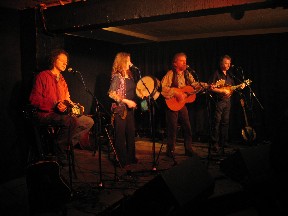
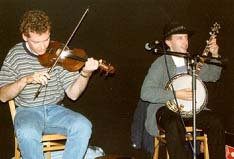
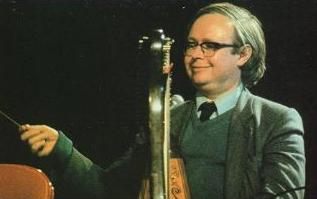
Left to right: The Sands Family, Craobh Rua, Derek Bell
|
To the German FolkWorld |
© The Mollis - Editors of FolkWorld; Published 11/2009
All material published in FolkWorld is © The Author via FolkWorld. Storage for private use is allowed and welcome. Reviews and extracts of up to 200 words may be freely quoted and reproduced, if source and author are acknowledged. For any other reproduction please ask the Editors for permission. Although any external links from FolkWorld are chosen with greatest care, FolkWorld and its editors do not take any responsibility for the content of the linked external websites.


 @
@