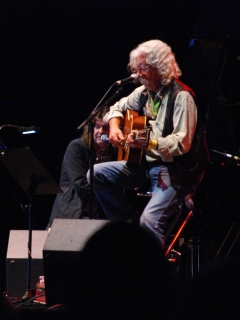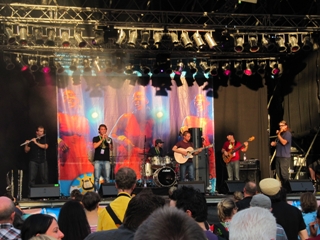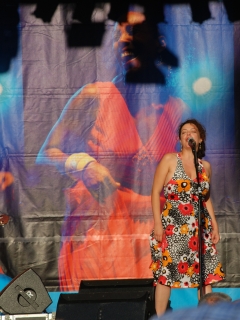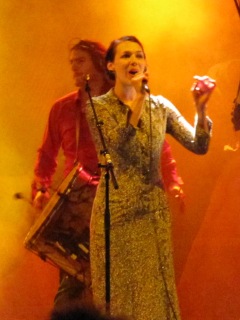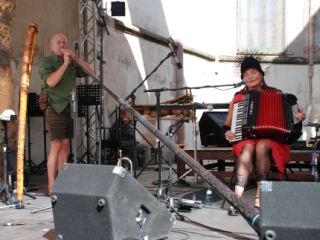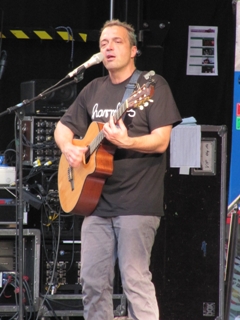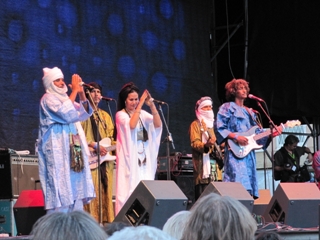
ÿþ<html> <head><title>FolkWorld Live Review: Bardentreffen 2010</title></head> <body bgcolor="#F5F5F5" link="#DC143C" alink="#FF3300" vlink="#4B0082"> <p> <table align="right" width=240 cellpadding=5 border=5 bgcolor="#dcdcdc" bordercolor="#F5F5F5"> <tr><td background="../p/adler.gif"><center> <br><p><b><font color="#ff0000" size=+2> Bardentreffen</font><br><font color="#ff0000" size=+3> Nürnberg</font></b></center><br><br> </td></tr> <tr><td> <p><center><b><a HREF="http://www.bardentreffen.de/"><font size=+1>www.bardentreffen.de</font></A> <br><br><a HREF="../../40/d/barde.html"><font size=+1>Bardentreffen 2009</font></A> <br><a HREF="../../37/d/barde.html">Bardentreffen 2008</A> <br><a HREF="../../34/d/barde.html"><font size=-1>Bardentreffen 2004-7</font></A> </b></center> </td></tr> </table> <font size=4 color="4169e1"><font FACE="Maiandra GD">FolkWorld</font> Issue 43 11/2010; Photo Report & Song Collection </font> </p><br> <center> <b><FONT SIZE=7 COLOR="#ff0000">Full Steam Ahead</FONT><br> <font color="#008000" size="4">Bardentreffen Nürnberg, 30 July - 1 Aug 2010</font></b> </CENTER> <p><font size=+1> Nürnberg and its Bardentreffen festival was all about the 175th rail anniversary: the steam-driven 'Adler' (Eagle) started to roll between Nürnberg and Fürth in 1835, covering the fives miles in fourteen minutes. Well, the artists came by car or plane, but for sure Arlo Guthrie & Co had their railroad songs on board. But let's not get fooled, Nürnberg's Bardentreffen is about listening to music not about trainspotting ... </font><br clear=all> <p><a name="arlo"></a><a name="city"></a><table align="center" cellpadding=5 border=5 bgcolor="#dcdcdc" bordercolor="#F5F5F5"> <tr><td valign=top> <font size=-1><blockquote> <!-- Steve Goodman City of New Orleans 1970 --> Riding on the City of New Orleans<br> Illinois Central Monday morning rail<br> Fifteen cars and fifteen restless riders<br> Three conductors and twenty-five sacks of mail<br> All along the southbound odyssey<br> The train pulls out at Kankakee<br> Rolls along past houses, farms and fields<br> Passin' towns that have no names<br> Freight yards full of old black men<br> And the graveyards of the rusted automobiles<br> <br> Good morning, America, how are you<br> Don't you know me, I'm your native son<br> I'm the train they call The City of New Orleans<br> I'll be gone five hundred miles when the day is done<br> <br> Dealin' cards with the old men in the club car<br> Penny a point, ain't no one keepin' score<br> Won't you pass the paper bag that holds the bottle<br> Feel the wheels rumblin' 'neath the floor<br> And the sons of pullman porters<br> And the sons of engineers<br> Ride their father's magic carpet made of steam<br> Mothers with their babes asleep<br> Are rockin' to the gentle beat<br> And the rhythm of the rails is all they dream<br> <br> Good morning, America, how are you ...<br> <br> Night time on The City of New Orleans<br> Changing cars in Memphis, Tennessee<br> Half way home, and we'll be there by morning<br> Through the Mississippi darkness<br> Rolling down to the sea<br> And all the towns and people seem<br> To fade into a bad dream<br> And the steel rails still ain't heard the news<br> The conductor sings his song again<br> The passengers will please refrain<br> This train's got the disappearing railroad blues<br> <br> Good morning, America, how are you ... </blockquote></font> </td><td valign=top> <p><center><img src="../p/arlo.jpg" width=240 height=320 border=0 alt="Arlo Guthrie & Wenzel"></center> <p><b>Arlo Guthrie @ FolkWorld:</b><br> <a href="../../32/d/cds1.html#guth">FW#32</a>, <a href="../../34/e/news.html#arlo">#34</a>, <a href="../../35/d/cds1.html#arlo">#35</a> <p><center><a HREF="http://www.arlo.net"><b>www.arlo.net</b></a></center> <p><b>Wenzel @ FolkWorld:</b><br> <a HREF="../../15/d/cds1.html#wenz">FW #15</a>, <a href="../../22/e/cds1.html#wenz">#22</a>, <a href="../../26/d/cds1.html#wenz">#26</a>, <a HREF="../../31/e/deutsch.html">#31</a>,<br> <a href="../../34/d/barde.html#wenzel">#34</a>, <a href="../../37/d/cds2.html#wenz">#37</a>, <a href="../../38/d/cds4.html#wenz">#38</a>, <a href="../../39/d/kind.html#wenzel">#39</a>, <a href="../../42/d/akkord.html#wenzel">#42</a> <p><center><a HREF="http://www.wenzel-im-netz.de"><b>www.wenzel-im-netz.de</b></a></center> <p><IMG SRC="../../p/icon_movie_kl.gif" height=19 width=26 alt="Icon Movie"> @ <a HREF="http://www.youtube.com/watch?v=oAJqTkOpmPE&feature=related">www.youtube.com</a> </td></tr> <tr><td width=640 colspan=2> <p><br><blockquote><font size=-1><b>City of New Orleans:</b> <i> A train ride from Chicago to New Orleans via the Illinois Central Railroad. Steve Goodman's song was a big hit for Arlo Guthrie in 1972. Goodman himself won a posthumous Grammy Award for Best Country Song in 1984 for Willie Nelson's version. </i></font></blockquote> </td></tr></table> <br clear=all><br> <p><a name="nim"></a><a name="poor"></a><table align="center" cellpadding=5 border=5 bgcolor="#dcdcdc" bordercolor="#F5F5F5"> <tr><td valign=top><p><center><img src="../p/nim.jpg" height=240 width=320 border=0 alt="Nim Sofyan"></center> <p><b>Nim Sofyan @ FolkWorld:</b> <a href="../../31/d/cds3.html#sofy">FW#31</a>, <a href="../../37/d/wackel.html">#37</a>, <a href="../../42/e/cds4.html#nims">#42</a> <p><IMG SRC="../../p/icon_sound_kl.gif" height=19 width=26 alt="Icon Sound"> @ <a HREF="http://www.myspace.com/nimsofyan">www.myspace.com/nimsofyan</a> <p><IMG SRC="../../p/icon_movie_kl.gif" height=19 width=26 alt="Icon Movie"> @ <a HREF="http://www.youtube.com/watch?v=UT8dd3QYLaA">www.youtube.com</a> <p><center><a HREF="http://www.nimsofyan.com"><b>www.nimsofyan.com</b></a></center> </td> <td width=530 valign=top><font size=-1><blockquote> <!-- Poor Paddy Works on the Railway --> In eighteen hundred and forty-one<br> My corduroy breeches I put on<br> My corduroy breeches I put on<br> To work upon the railway, the railway<br> I'm weary of the railway<br> Poor Paddy works on the railway<br> <br>I was wearing corduroy britches, digging ditches, pulling switches<br> Dodging pitches, I was working on the railway<br> <br> In eighteen hundred and forty-two, I didn't know what I should do ... <br><br> In eighteen hundred and forty-three, I sailed away across the sea ... <br><br> In eighteen hundred and forty-four, I landed on Columbia's shore ... <br><br> In eighteen hundred and forty-five, when Daniel O'Connell he was alive ... <br><br> In eighteen hundred and forty-six, I made my trade to carrying bricks ... <br><br> In eighteen hundred and forty-seven, poor Paddy was thinking of going to Heaven ... </font> <p><font size=-1><b>Poor Paddy Works on the Railway:</b> <i>A popular Irish-American folk song, sometimes sung as a sea chanty. The Pogues did it too. During the 19th century, many of the men who built the American railroads were Irish immigrants. </i></font></blockquote> </td></tr> </table> <br clear=all><br> <p><a name="oquest"></a><a name="drill"></a><table align="center" cellpadding=5 border=5 bgcolor="#dcdcdc" bordercolor="#F5F5F5"> <tr><td valign=top> <font size=-1><blockquote> <!-- Drill Ye Tarriers Thomas Casey & Charles Connolly--> Early one morning 'bout seven o'clock<br> There was twenty tarriers drilling at the rock<br> The boss came along and he says: keep still <br> And come down heavy with your cast iron drill<br> <br> And drill ye tarriers drill, drill ye tarriers drill<br> It's work all day for the sugar in your tea <br> Down behind the railway<br> And drill ye tarriers drill, and blast, and fire<br> <br> The boss was a fine man down on the ground<br> And he married a lady six feet round<br> She baked good bread and she baked it well<br> But she baked so hard as the hole of the hell<br> <br> And drill ye tarriers drill ...<br> <br> Now the new foreman was John McCann <br> By God, he was a mighty hard man<br> Last week a primature blast went off <br> And up in the sky went Big Jim Goff<br> <br> And drill ye tarriers drill ...<br> <br> Next time pay day came around<br> Jim Goff a dollar short was found<br> When he asked the reason, came this reply:<br> You were docked for the time you were up in the sky<br> <br> And drill ye tarriers drill ... </blockquote></font> </td> <td valign=top> <p><center><img src="../p/oquestrada.jpg" width=240 height=320 border=0 alt="OqueStrada"></center> <p><b>OqueStrada @ FolkWorld:</b> <a href="../d/cds2.html#oque">FW#43</a> <p><IMG SRC="../../p/icon_sound_kl.gif" height=19 width=26 alt="Icon Sound"> @ <a HREF="http://www.myspace.com/oquestrada">www.myspace.com/oquestrada</a> <p><IMG SRC="../../p/icon_movie_kl.gif" height=19 width=26 alt="Icon Movie"> @ <a HREF="http://www.youtube.com/watch?v=ZGDYa0abSXk">www.youtube.com</a> <p><center><a HREF="http://www.oquestrada.com"><b>www.oquestrada.com</b></a></center> </td></tr> <tr><td width=600 colspan=2> <p><br><blockquote><font size=-1><b>Drill Ye Tarriers:</b><i> Tarriers were the men drilling holes and blasting away rock to make way for track. The words of the song are attributed to one Thomas F. Casey, himself a tarrier and occasional entertainer; Charles Connolly is credited with the music (1888). </i></font></blockquote> </td></tr></table> <br clear=all><br> <p><a name="tina"></a><a name="henry"></a><table align="center" cellpadding=5 border=5 bgcolor="#dcdcdc" bordercolor="#F5F5F5"> <tr><td width=320 valign=top><p><center><img src="../p/tinariwen.jpg" height=240 width=320 border=0 alt="Tinariwen"></center> <p><b>Tinariwen @ FolkWorld:</b> <a href="../../33/e/cds2.html#tina">FW#33</a>, <a href="../../35/d/news.html#prat">#35</a>, <a href="../../38/d/cds1.html#tina">#38</a>, <a href="../../42/d/tamikrest.html">#42</a> <p><IMG SRC="../../p/icon_sound_kl.gif" height=19 width=26 alt="Icon Sound"> @ <a HREF="http://www.myspace.com/tinariwen">www.myspace.com/tinariwen</a> <p><IMG SRC="../../p/icon_movie_kl.gif" height=19 width=26 alt="Icon Movie"> @ <a HREF="http://www.youtube.com/watch?v=4-t6-XY7C7A">www.youtube.com</a> <p><center><a HREF="http://www.tinariwen.com"><b>www.tinariwen.com</b></a></center> <p><br><blockquote><font size=-1><b>The Ballad of John Henry:</b><i> John Henry is probably the most frequently performed and recorded American folk song (Josh White devoted an entire LP side to different versions). The song deals with the digging of the Big Bend Tunnel in West Virginia in the 1870s. John Henry is notable for having raced against a steam powered hammer and won - only to die in victory with his hammer in his hand. </i></font></blockquote></td> <td valign=top><font size=-1><blockquote> <!-- Ballad of John Henry --> Some say he's from Georgia, some say he's from Alabam,<br> But it's wrote on the rock at the Big Ben Tunnel, that he's an East Virginia Man.<br> John Henry was a steel drivin' man, he died with a hammah in his han',<br> Oh, come along boys and line the track for John Henry ain't never comin' back.<br> John Henry he could hammah, he could whistle, he could sing,<br> He went to the mountain early in the mornin' to hear his hammah ring.<br> John Henry went to the section boss, says the section boss what kin you do?<br> Says I can line a track, I kin histe a jack, I kin pick and shovel too.<br> John Henry told the cap'n, when you go to town,<br> Buy me a nine pound hammah an' I'll drive this steel drill down.<br> Cap'n said to John Henry, you've got a willin' mind.<br> But you just well lay yoh hammah down, you'll nevah beat this drill of mine.<br> John Henry went to the tunnel and they put him in lead to drive,<br> The rock was so tall and John Henry so small that he laid down his hammah and he cried.<br> The steam drill was on the right han' side, John Henry was on the left,<br> Says before I let this steam drill beat me down, I'll hammah myself to death.<br> Oh the cap'n said to John Henry, I bleeve this mountain's sinkin' in.<br> John Henry said to the cap'n, Oh my! tain't nothin' but my hammah suckin' wind.<br> John Henry had a cute liddle wife, and her name was Julie Ann,<br> And she walk down the track and nevah look back, goin' to see her brave steel drivin' man.<br> John Henry had a pretty liddle wife, she come all dressed in blue.<br> And the last words she said to him, John Henry I been true to you.<br> John Henry was on the mountain, the mountain was so high,<br> He called to his pretty liddle wife, said Ah kin almos' touch the sky.<br> Who gonna shoe yoh pretty liddle feet, who gonna glove yoh han',<br> Who gonna kiss yoh rosy cheeks, an' who gonna be yoh man?<br> Papa gonna shoe my pretty liddle feet, Mama gonna glove my han',<br> Sistah gonna kiss my rosy cheeks, an' I ain't gonna have no man.<br> Then John Henry told huh, don't you weep an' moan,<br> I got ten thousand dollars in the First National Bank, I saved it to buy you a home.<br> John Henry took his liddle boy, sit him on his knee,<br> Said that Big Ben Tunnel gonna be the death of me.<br> John Henry took that liddle boy, helt him in the pahm of his han',<br> And the last words he said to that chile was, I want you to be a steel drivin' man.<br> John Henry ast that liddle boy, now what are you gonna be?<br> Says if I live and nothin' happen, a steel drivin' man I'll be.<br> Then John Henry he did hammah, he did make his hammah soun',<br> Says now one more lick fore quittin' time, an' I'll beat this steam drill down.<br> The hammah that John Henry swung, it weighed over nine poun',<br> He broke a rib in his left han' side, and his intrels fell on the groun'.<br> All the women in the West that heard of John Henry's death,<br> Stood in the rain, flagged the east bound train, goin' where John Henry dropped dead.<br> John Henry's liddle mother was all dressed in red,<br> She jumped in bed, covered up her head, said I didn't know my boy was dead.<br> They took John Henry to the White House, and buried him in the san', <br> And every locomotive come roarin' by, says there lays that steel drivin' man. </blockquote></font></td> </tr></table> <br clear=all><br> <p><a name="valravn"></a><a name="wabash"></a><table align="center" cellpadding=5 border=5 bgcolor="#dcdcdc" bordercolor="#F5F5F5"> <tr><td valign=top><p><center><img src="../p/valravn.jpg" width=240 height=320 border=0 alt="Valravn"></center> <p><b>Valravn @ FolkWorld:</b> <a href="../../39/e/valravn.html">FW#39</a>, <a href="../../41/e/cds4.html#valr">#41</a> <p><IMG SRC="../../p/icon_sound_kl.gif" height=19 width=26 alt="Icon Sound"> @ <a HREF="http://www.myspace.com/valravn">www.myspace.com/valravn</a> <p><IMG SRC="../../p/icon_movie_kl.gif" height=19 width=26 alt="Icon Movie"> @ <a HREF="http://www.youtube.com/watch?v=uX6WMFXUuwQ">www.youtube.com</a> <p><center><a HREF="http://www.valravn.net"><b>www.valravn.net</b></a></center> </td><td valign=top><font size=-1><blockquote> <!-- Wabash Cannonball Ende des 19. Jahrhunderts --> From the great Atlantic Ocean to the wide Pacific shore<br> From the green and flowing mountains to the south belt by the shore<br> She's mighty tall and handsome, and known quite well by all<br> She's the combination on the Wabash Cannonball<br> <br> Listen to the jingle, the rumble and the roar<br> As she glides along the woodland, through the hills and by the shore<br> Hear the mighty rush of the engine, hear that lonesome hobo squall<br> You're travelling through the jungles on the Wabash Cannonball<br> <br> She came down from Birmingham, one cold December day<br> As she rolled into the station, you could hear all the people say<br> There's a girl from Tennessee, she's long and she's tall<br> She came down from Birmingham on the Wabash Cannonball<br> <br> Listen to the jingle, the rumble and the roar ...<br> <br> Our the Eastern states are dandy so the people always say<br> From New York to St. Louis and Chicago by the way<br> From the hills of Minnesota where the rippling waters fall<br> No changes can be taken on that Wabash Cannonball<br> <br> Listen to the jingle, the rumble and the roar ...<br> <br> Here's to daddy Claxton, may his name forever stand<br> And always be remembered 'round the courts of Alabam'<br> His earthly race is over and the curtains 'round him fall<br> We'll carry him home to victory on the Wabash Cannonball<br> <br> Listen to the jingle, the rumble and the roar ... </blockquote></font> </td></tr> <tr><td width=700 colspan=2> <p><br><blockquote><font size=-1><b>Wabash Cannonball:</b> <i> Hobos imagined a mythical, Flying Dutchman of a train. The Carter Family made one of the first recordings of the song in 1929. </i></font></blockquote> </td></tr></table> <br clear=all><br> <p><a name="hammer"></a><a name="freight"></a><table align="center" cellpadding=5 border=5 bgcolor="#dcdcdc" bordercolor="#F5F5F5"> <tr><td width=320 valign=top><p><center><img src="../p/hammer.jpg" height=240 width=320 border=0 alt="Hammerling trifft Michaela Dietl"></center> <p><b>Hammerling @ FolkWorld:</b> <a href="../../38/e/cds4.html#hamm">FW#38</a> <p><IMG SRC="../../p/icon_movie_kl.gif" height=19 width=26 alt="Icon Movie"> @ <a HREF="http://www.youtube.com/watch?v=f3LA72GxZcQ">www.youtube.com</a> <p><center><b><a href="http://www.hammerling.info">www.hammerling.info</a> <br> <a href="http://www.michaela-dietl.de">www.michaela-dietl.de</a> </b></center> </td> <td valign=top><font size=-1><blockquote> <!-- Freight Train Elizabeth Cotten --> Freight train, freight train, run so fast<br> Freight train, freight train, run so fast<br> Please don't tell what train I'm on<br> They won't know what route I'm going<br> <br> When I'm dead and in my grave<br> No more good times here I crave<br> Place the stones at my head and feet<br> And tell them all I've gone to sleep<br> <br> When I die, oh bury me deep<br> Down at the end of old Chestnut Street<br> So I can hear old Number Nine<br> As she comes rolling by<br> <br> When I die, oh bury me deep<br> Down at the end of old Chestnut Street<br> Place the stones at my head and feet<br> And tell them all I've gone to sleep<br> <br> Freight train, freight train, run so fast<br> Freight train, freight train, run so fast<br> Please don't tell what train I'm on<br> They won't know what route I'm going </blockquote></font> </td></tr> <tr><td width=630 colspan=2> <p><br><blockquote><font size=-1><b>Freight Train:</b> <i>Elizabeth Cotten (1895-1987) was discovered in 1946 when working for the Seeger family as a housekeeper. A self-taught, left-handed guitar player, she composed her best-known song "Freight Train" when she was a child. </i></font></blockquote> </td></tr></table> <br clear=all><br> <p><a name="goetz"></a><a name="rock"></a><table align="center" cellpadding=5 border=5 bgcolor="#dcdcdc" bordercolor="#F5F5F5"> <tr><td valign=top> <font size=-1><blockquote> <!-- "Rock Island Line" nach 1900 written by Kelly Pace --> Now this here's a story about the Rock Island Line<br> Well the Rock Island Line she runs down into New Orleans<br> There's a big tollgate down there and you know<br> If you got certain things on board when you go through the tollgate<br> Well you don't have to pay the man no toll<br> Well a train driver he pulled up to the tollgate<br> And a man hollered and asked him what all he had on board and said<br> I got livestock, I got livestock, I got cows, I got pigs, I got sheep,<br> I got mules, I got all livestock<br> Well he said you're all right boy you don't have to pay no toll<br> You can just go right on through so he went on through the toolgate<br> And as he went through he started pickin' up a little bit of speed<br> Pickin' up a little bit of steam<br> He got on through he turned and looked back at the man he said<br> Well I fooled you, I fooled you, I got pigiron, I got pigiron, I got old pigiron<br> <br> Down the Rock Island Line she's a mighty good road<br> Rock Island Line it's a road to ride<br> Rock Island Line it's a mighty good road<br> Well if you ride you got to ride it like you finally get your ticket <br> At the station for the Rock Island Line<br> <br> Looked cloudy in the west and it looked like rain<br> Round the curve came a passenger train<br> North bound train on the southbound track <br> He's alright a leavin' but he won't be back<br> <br> Well the Rock Island Line she's a mighty good road ...<br> <br> Oh I may be right and I may be wrong <br> But you gonna miss me when I'm gone<br> Well the engineer said before he died<br> There were two more drinks that he'd like to try<br> The conductor said what could they be <br> A hot cup of coffee and a cold glass of tea<br> <br> Well the Rock Island Line she's a mighty good road ... </blockquote></font> </td> <td width=240 valign=top> <p><center><img src="../p/goetz.jpg" width=240 height=320 border=0 alt="Götz Widmann"></center> <p><b>Götz Widmann @ FolkWorld:</b> <a href="../../23/d/cds2.html#join">FW#23</a>, <a href="../../26/d/cds2.html#widm">#26</a>, <a href="../../33/d/cds3.html#widm">#33</a>, <a href="../../37/d/cds4.html#widm">#37</a>, <a href="../../42/d/cds2.html#widm">#42</a> <p><IMG SRC="../../p/icon_sound_kl.gif" height=19 width=26 alt="Icon Sound"> @ <a HREF="www.myspace.com/goetzwidmann"><font size=-1>www.myspace.com/goetzwidmann</font></a> <p><IMG SRC="../../p/icon_movie_kl.gif" height=19 width=26 alt="Icon Movie"> @ <a HREF="http://www.youtube.com/watch?v=0JTQQhUikt4">www.youtube.com</a> <p><center><a HREF="http://www.goetzwidmann.de"><b>www.goetzwidmann.de</b></a></center> </td></tr> <tr><td width=750 colspan=2> <p><br><blockquote><font size=-1><b>Rock Island Line:</b><i> The song is about the Chicago, Rock Island and Pacific Railroad, first recorded by the Lomaxes and Leadbelly in 1934 from prison inmates. It became a huge hit for British skiffle musician Lonnie Donegan in the 1950s. </td></tr></table> <br clear=all><br> <p><a name="katz"></a><a name="casey"></a><table align="center" cellpadding=5 border=5 bgcolor="#dcdcdc" bordercolor="#F5F5F5"> <tr><td width=320 valign=top><p><center><img src="../p/katz.jpg" height=240 width=320 border=0 alt="Katzenjammer"></center> <p><b>Katzenjammer @ FolkWorld:</b> <a href="../../42/e/cds8.html#katz">FW#42</a> <p><IMG SRC="../../p/icon_sound_kl.gif" height=19 width=26 alt="Icon Sound"> @ <a HREF="http://www.myspace.com/katzenjammerne">www.myspace.com/katzenjammerne</a> <p><IMG SRC="../../p/icon_movie_kl.gif" height=19 width=26 alt="Icon Movie"> @ <a HREF="http://www.youtube.com/watch?v=HBFpvzZMHVI">www.youtube.com</a> <p><center><a HREF="http://www.katzenjammer.no"><b>www.katzenjammer.no</b></a></center> <p><br><blockquote><font size=-1><b>The Ballad of Casey Jones:</b><i> Engineer John Luther Jones was killed when the Southbound Passenger Train #1 of the Illinois Central Railroad collided with a stopped freight train on 30 April 1900. The incidence spawned a number of songs, (including one by blues guitarist Walter 'Furry' Lewis (1893-1981) who himself lost a leg in a railroad accident in 1917). This song here was made up by Wallace Saunders, a black engine wiper in the railroad shop at Canton. Legend has it that vaudeville performers Frank and Bert Leighton added a chorus to the tune. When the song was first published in 1902, it was credited to T. Lawrence Seibert (music) and Eddie Newton (words). </i></font></blockquote></td> <td valign=top><font size=-1><blockquote> <!-- THE BALLAD OF CASEY JONES --> Come all you rounders if you want to hear <br> A story 'bout a brave engineer, <br> Casey Jones was the rounder's name <br> "Twas on the Illinois Central that he won his fame. <br> <br> Casey Jones, he loved a locomotive. <br> Casey Jones, a mighty man was he. <br> Casey Jones run his final locomotive <br> With the Cannonball Special on the old I.C. <br> <br> Casey pulled into memphis on Number Four, <br> The engine foreman met him at the roundhouse door; <br> Said, "Joe Lewis won't be able to make his run <br> So you'll have to double out on Number One." <br> <br> If I can have Sim Webb, my fireman, my engine 382, <br> Although I'm tired and weary, I'll take her through. <br> Put on my whistle that come in today <br> Cause I mean to keep her wailing as we ride and pray. <br> <br> Casey Jones, mounted the cabin, <br> Casey Jones, with the orders in his hand. <br> Casey Jones, he mounted the cabin, <br> Started on his farewell Journey to the promised land. <br> <br> They pulled out of Memphis nearly two hours late, <br> Soon they were speeding at a terrible rate. <br> And the people knew by the whistle's moan. <br> That the man at the throttle was Casey Jones. <br> <br> Need more coal there, fireman Sim, <br> Open that door and heave it in. <br> Give that shovel all you got <br> And we'll reach Canton on the dot<br> <br> On April 30, 1900, that rainy morn, <br> Down in Mississippi near the town of Vaughan, <br> Sped the Cannonball Special only two minutes late <br> Traveling 70 miles an hour when they saw a freight. <br> <br> The caboose number 83 was on the main line, <br> Casey's last words were "Jump, Sim, while you have the time. <br> "At 3:52 that morning came the fareful end, <br> Casey took his farewell trip to the promised land. <br> <br> Casey Jones, he died at the throttle, <br> With the whistle in his hand. <br> Casey Jones, he died at the throttle, <br> But we'll all see Casey in the promised land. <br> <br> His wife and three children were left to mourn <br> The tragic death of Casey on that April morn. <br> May God through His goodness keep them by His grace<br> Till they all meet together in that heavenly place. <br> <br> Casey's body lies buried in Jackson, Tennessee <br> Close beside the tracks of the old I.C. <br> May his spirit live forever throughout the land <br> As the greatest of all heroes of a railroad man. <br> <br> Casey Jones, he died at the throttle ... </blockquote></font></td> </tr></table> <br clear=all><br> <table align="right" cellpadding=5 border=5 bgcolor="#dcdcdc" bordercolor="#F5F5F5"> <tr><td><center><img src="../p/railroad.jpg" width=122 height=122 border=0 alt="Classic Railroad Songs"></center> <font size=-1><a href="../../32/d/cds2.html#smif">Classic Railroad Songs<br> Smithsonian Folkways<br>SFW CD 40912</a></font></td></tr></table> <p align=center><img src="../../34/p/nuremberg.jpg" height=142 width=652 alt="Nuremberg, Germany"></p> <p><font size=-1><b>Photo Credits:</b><i> (1) <a href="http://en.wikipedia.org/wiki/Adler_(locomotive)">Adler</a> (unknown); (2) <a href="http://www.arlo.net">Arlo Guthrie</a> & <a href="http://www.wenzel-im-netz.de">Wenzel</a>, (4) <a href="http://www.oquestrada.com">Oquestrada</a>, (7) <a href="http://www.hammerling.info">Hammerling</a> trifft <a href="http://www.michaela-dietl.de">Michaela Dietl</a>, (by Tom Kamphans); (3) <a href="http://www.nimsofyan.com">Nim Sofyan</a>, (5) <a href="http://www.tinariwen.com">Tinariwen </a>, (6) <a href="http://www.valravn.net">Valravn</a>, (8) <a href="http://www.goetzwidmann.de">Götz Widmann</a>, (10) Nürnberg (by Walkin' Tom); (9) <a href="http://www.katzenjammer.no">Katzenjammer</a> (by Dorthe Lübbert); (11) 'Classic Railroad Songs' (by <a href="http://www.folkways.si.edu">Smithsonian Folkways</a>). </i></font> <br><br> <hr COLOR="#800080"> <p><table align="center" bgcolor="#dcdcdc" cellpadding=20 border=5 bordercolor="#F5F5F5"> <tr><td> <p><center> <font size=4> <a HREF="index.html#up">Back to FolkWorld Content</a><br> <a HREF="../d/index.html#up">To the German FolkWorld</a> </font> </center> </td></tr> </table> <p> <font size=-1>&#169; <a HREF="../../fw/staff.html">The Mollis</a> - Editors of <font face="Maiandra GD">FolkWorld</font>; Published 11/2010</font> <p><FONT FACE="Arial" SIZE=-2>All material published in FolkWorld is &#169; The Author via FolkWorld. Storage for private use is allowed and welcome. Reviews and extracts of up to 200 words may be freely quoted and reproduced, if source and author are acknowledged. For any other reproduction please ask the Editors for permission. Although any external links from FolkWorld are chosen with greatest care, FolkWorld and its editors do not take any responsibility for the content of the linked external websites. </font> <hr color="#0000CD"> <CENTER> <FONT FACE="Arial" SIZE=-2>FolkWorld - Home of European Music</FONT><BR> <A HREF="http://www.folkworld.eu/"><IMG SRC="../../p/fw.jpg" WIDTH="360" HEIGHT="54" BORDER="0" ALT="FolkWorld Home"></A> <BR> <FONT FACE="Arial" SIZE=-2>Layout &amp; Idea of FolkWorld &#169; <a HREF="../../fw/staff.html">The Mollis</a> - Editors of FolkWorld</FONT> </CENTER> </body> </html>